
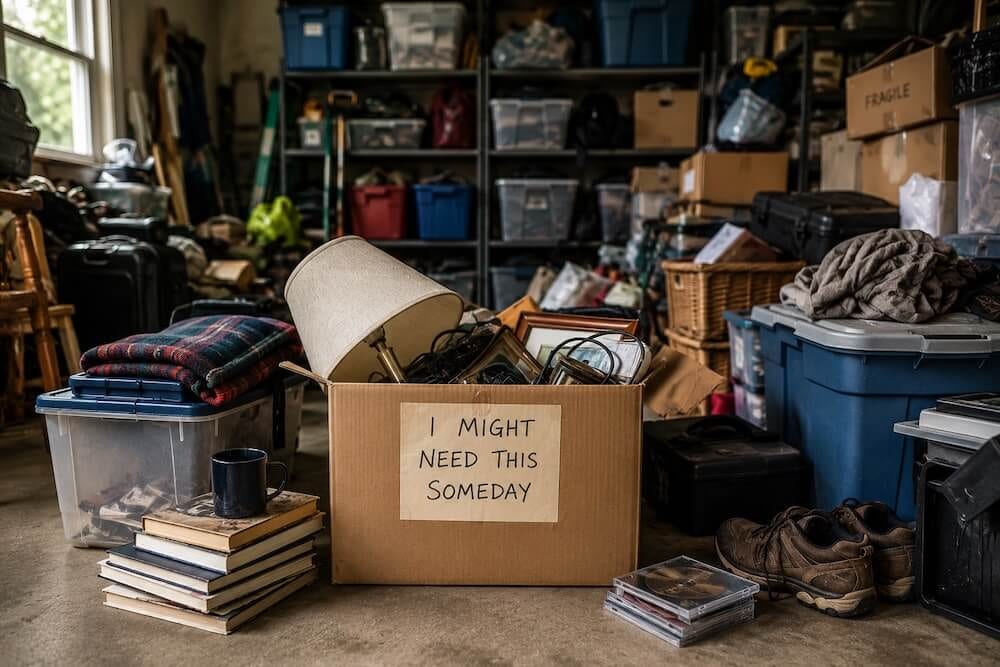
You know the box. The one that's been sitting in the garage for six years. The one you haven't opened it.
You barely remember what's inside. But the moment someone suggests getting rid of it...
Or maybe it's...
"I paid good money for that."
"I'm going to sell that."
"They don't make those anymore."
"There's nothing wrong with it."
And technically, you may be right. But there's an interesting connection between the things we hold onto and the way we think about money.
|
 |
 |
The Money Is Already Gone |
Imagine you bought something for $500 five years ago. You haven't used it in three years.
Today it's probably worth $100. But getting rid of it feels painful because you remember paying $500.
That's called the sunk-cost effect. We allow money we've already spent to influence what we do next.
Keeping the item won't bring the $500 back. That financial decision happened five years ago.
Does this thing still provide enough value to justify keeping it?
That same thinking applies to finances.
We sometimes continue subscriptions, memberships, investments or even financial decisions simply because we've already put money into them.
What you paid yesterday shouldn't automatically determine what you keep today. |

 |
What Your Stuff Might Be Telling You About Money |
"I might need it someday."
This can come from a desire for security.
Ask yourself... If I needed this again, how difficult or expensive would it actually be to replace?
Keeping something you don't use doesn't recover the purchase price.
Sometimes letting go simply means accepting that the purchase served its purpose or wasn't as useful as expected.
"I'm going to sell it."
I love this one.
There are probably millions of dollars sitting in American garages waiting to be sold "someday."
If something has real resale value, give yourself a deadline.
List it. Turn the object back into money.
Otherwise, be honest about whether you're actually going to sell it.
"There's nothing wrong with it."
Donation can turn something collecting dust into something valuable again.
Sometimes we're holding onto things because we're afraid we won't have the resources to replace them.
That may be worth examining.
The goal isn't to own everything you could possibly need.
The goal is to build enough financial security that you trust yourself to handle future needs when they arise. |
 |
Your Stuff Isn't Free Just Because You Own It |
Possessions have costs we rarely calculate.
Did you just read all that?!
At some point we have to ask...
Financial freedom isn't only about having enough money. Sometimes it's about needing less to feel secure. |

 |
Try The 30 Minute Money And Clutter Challenge |
Pick one small area this week... Not the whole house.
Create three groups...
SELL
LET GO
Then pay attention to the thoughts that appear.
|
I think this is where many of us get stuck.
That's okay too.
Take the lesson... and move forward.
Sell what has value.
And when you're about to buy the next thing...
Remember the box that's been sitting in your garage for six years.
That might be the best financial lesson in the house.
What's something you've been holding onto because you keep telling yourself, "I might need that someday"?
Just to let you know, I struggle with this, so you aren't alone.
Until next week,
Disclaimer: Guide to Perfect Credit and Credit Coach Rob provide financial education and coaching based on personal experience and research. We are not licensed financial advisors, accountants or attorneys. This content is for informational purposes only and should not be considered financial, legal or tax advice. Always consult with a certified professional for your specific situation. |

Get The 850 Pin! |
It’s more than a number... it’s a symbol of the journey. My journey started with free t-shirts and ended at 850.
What's yours?
#850Journey #CreditComeback #YouGotThis |